How Indonesia Connects to the World
Almost all of Indonesia's international internet traffic travels through submarine fiber-optic cables. Light pulses carry data through these cables at roughly two-thirds the speed of light in a vacuum, which is why a request from Jakarta can reach a server in another country in milliseconds.
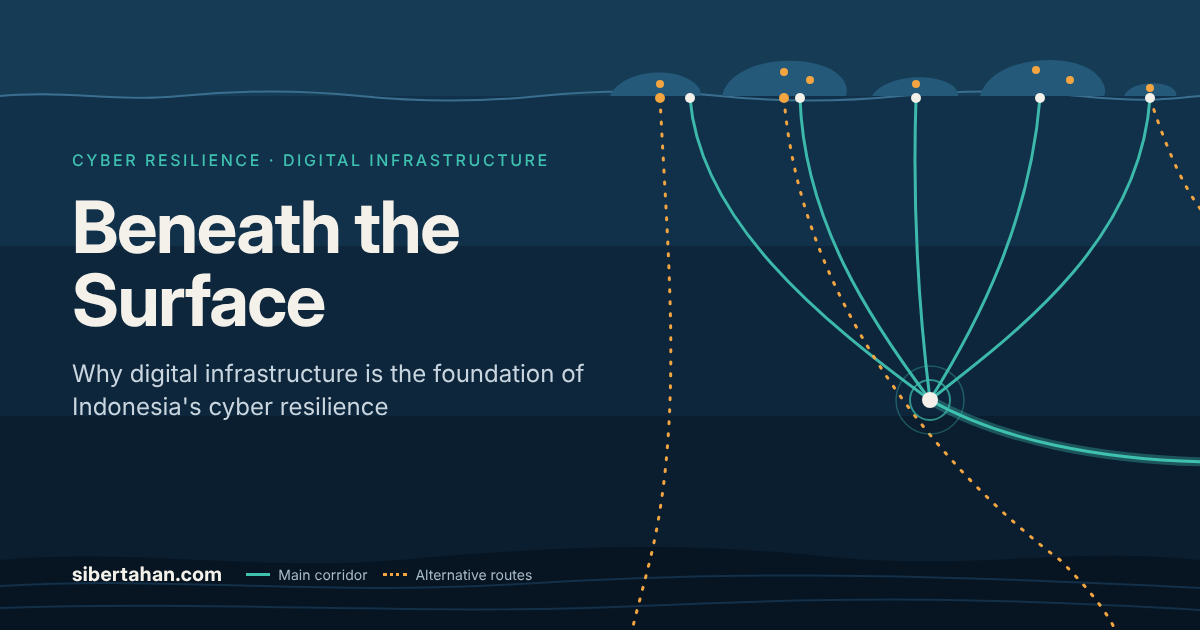
The network is large. Industry reporting in mid-2026 counted 72 subsea cables touching Indonesia, 42 domestic and 30 international. But size is not the same as diversity. According to the Ministry of Communication and Digital Affairs (Komdigi), around 90% of Indonesia's international traffic passes through a single neighboring hub.
That concentration is not an accident or a policy failure. That hub is the region's busiest digital crossroads: it hosts dense cable landings, major data centers, and the peering points where global networks meet. Routing through it is often the cheapest and fastest option, and it has served Indonesia well. The trade-off is simply that a large share of the country's connectivity shares one corridor, and any single corridor is a point of concentration.
The Concentration Risk
When many cables converge on one corridor, a single event can affect many of them at once. Subsea cables are damaged every year, mostly by ship anchors and fishing gear, sometimes by earthquakes and seabed landslides, and any other force majeure related events.
If that main corridor were seriously disrupted, traffic would not stop. It would be rerouted over the remaining paths, and that is where the pain begins:
- Latency jumps. A round trip from Jakarta to the regional hub normally takes on the order of 10–20 milliseconds. Traffic forced onto a longer detour, through the Pacific or via Australia, can take several times longer.
- Congestion follows. The surviving routes were never sized to carry 90% of the country's international load. Expect packet loss and throughput drops at peak hours.
- Cloud-dependent services degrade. Any workload hosted in an overseas cloud region, from SaaS tools and payment gateways to backup jobs and API calls, becomes slow or unreliable.
To put it simply, this could result in longer loading for casual internet users, but it could seriously disrupt the business with smooth internet connections as their fundamental part – digital economy.
This is not hypothetical. In December 2025, a fault on one major
Australia–Southeast Asia cable pushed
traffic onto other international paths, and users noticed higher latency to
services hosted elsewhere in the region. The network survived; performance did
not.
Myth vs. Fact: Would Indonesia Go Dark.
Myth: If the cables in the main regional corridor were heavily disrupted, Indonesia's internet would go completely dark.
Fact: It would not, for two separate reasons:
1. Domestic traffic stays at home, thanks to Internet Exchange Points (IXPs)
An IXP is a physical meeting point where internet service providers, content networks, and cloud providers exchange traffic directly with each other. When a user in Surabaya opens a website hosted in Jakarta, an IXP lets that traffic stay inside Indonesia instead of making a round trip abroad. Indonesia has a mature IXP ecosystem: as of April 2026, the Internet Society counted 58 active IXPs with 1,277 member networks. The largest, the Indonesia Internet Exchange (IIX) run by APJII, has operated since 1997.
2. Some international routes take a different path
Telkom's IGG system links to the SEA-US cable at Manado, an alternative path through Indonesian waters and the Pacific, and the Bifrost system was built partly to serve as a backup for severed cables. Other systems connect Indonesia toward Australia. So a corridor disruption would mean a slow, congested internet for anything international, not a blackout. Local banking apps, government portals, and services hosted in Indonesian data centers would largely keep working.
Why Today's Diversification is Not Enough
The current setup prevents a blackout, but it does not protect performance. Three gaps stand out.
- IXPs are concentrated in a few cities
Jakarta alone hosts the bulk of member networks. The Internet Society notes that IXPs are present in only 17 of Indonesia's 45 population centers above 300,000 people. Where there is no local exchange, even domestic traffic may travel long distances, sometimes abroad, before reaching its destination.
- Alternative international routes are thin
The alternative paths exist, but they carry a small fraction of total capacity. They can absorb a share of rerouted traffic, not the whole national load.
- Content still lives abroad
Much of what Indonesian users and businesses depend on, including SaaS platforms, software updates, and many cloud workloads, is still served from outside the country. No amount of domestic peering helps if the content itself is on the other side of a congested link.
In short, Indonesia has diversity in its exchange points but not yet enough diversity in its international routes or in where its data lives.
The Way Forward: More Exchanges, More routes
The fix is not a single new cable. It is a layered strategy, and expanding IXPs is its foundation.
1. Expand IXPs beyond Java
Every major regional city should have a well-connected local exchange, with hyperscalers, CDNs, and ISPs present. The more traffic that can be exchanged close to users, the less depends on any international link.
2. Pair IXPs with local content and cloud
An exchange is only as valuable as what is reachable through it. Several major cloud providers already operate regions in Jakarta; encouraging CDN caches and cloud on-ramps at regional IXPs keeps everyday services local.
3. Diversify international landing routes
New systems should land at different points and head in different directions: the Pacific, Australia, and the Indian Ocean, not only through one corridor. Telin has described its Indonesia Cable Express initiative as creating unique routes with diverse landing points, and projects such as Hawaiki Nui 1 aim to open new paths via northern Australia.
4. Strengthen terrestrial and domestic backbones
Komdigi says it is aligning roadmaps for data centers, submarine cables, and terrestrial networks so they grow together. That coordination matters: a new landing station is only useful if inland fiber can carry its traffic.
Good Bilateral Relationships With Neighbors are Part of the Infrastructure
Cables cross borders, so no country can build resilience alone. Strong, stable relationships with neighboring countries are one of the most effective and least expensive ways to reduce the impact of a disruption.
- Faster repairs
A damaged cable often lies in, or passes through, another country's waters. Repairs need permits, and only a few repair ships serve the region. Good working relationships shorten the time from fault to fix. In January 2026, ASEAN digital ministers endorsed Enhanced Guidelines for Strengthening Resilience and Repair of Submarine Cables, which encourage streamlined permits and a single government contact point for repairs.
- Shared protection and early warning
Neighbors that exchange information on ship traffic, seabed hazards, and incidents can prevent damage and respond faster. ASEAN set up a working group on submarine cables in 2024 for exactly this kind of regular exchange.
- Joint investment in new capacity
Cross-border projects share cost and risk. The Nongsa–Changi cable between Batam and Singapore, inaugurated in July 2026, adds more than 1.6 petabits per second of capacity, while projects with Australia and other partners open routes in new directions.
- Pre-agreed backup arrangements
Carriers and governments can agree in advance to share spare capacity or reroute traffic during an outage. A fault then triggers a plan, not a scramble. Diplomacy and diversification reinforce each other. More routes give Indonesia options; good relationships make sure each of those routes can be kept running and repaired quickly when it matters.
Conclusion
Indonesia's internet would not go dark if its busiest corridor were severely disrupted, and that resilience is real. But staying online is a low bar. A digital economy depends on staying fast, and that requires more exchange points across the archipelago, more international routes in more directions, more of the data Indonesians use living inside the country, and close cooperation and good bilateral relationship with the neighbors whose waters and networks we share.
Cyber resilience starts on the seabed. Infrastructure decisions made today will decide how well Indonesia weathers the next disruption.
Sources
- Komdigi on diversifying international internet routes — IDNFinancials
- Indonesia's subsea cable footprint and route diversity — ThreatCluster
- IXP Tracker: Indonesia — Internet Society Pulse
- Launch of IIX-JK2 internet exchange — Indonesia Business Post
- Telkom builds Bifrost SKKL — Telkom Indonesia
- Update on routes to Singapore and Southeast Asia — Neptune
- Indonesia as an emerging subsea cable hub — Capacity
- BW Digital and Telin partner on Hawaiki Nui 1 — Intelligent CIO
- Nongsa–Changi submarine cable inaugurated — RRI
- Enhanced ASEAN Guidelines for submarine cable resilience and repair — MDDI
- Critical underwater infrastructure protection in ASEAN — NUS Centre for International Law